Educational Dinosaur Identification Chart Art Print, vintage watercolor, classroom decor, dinosaur gift for kids
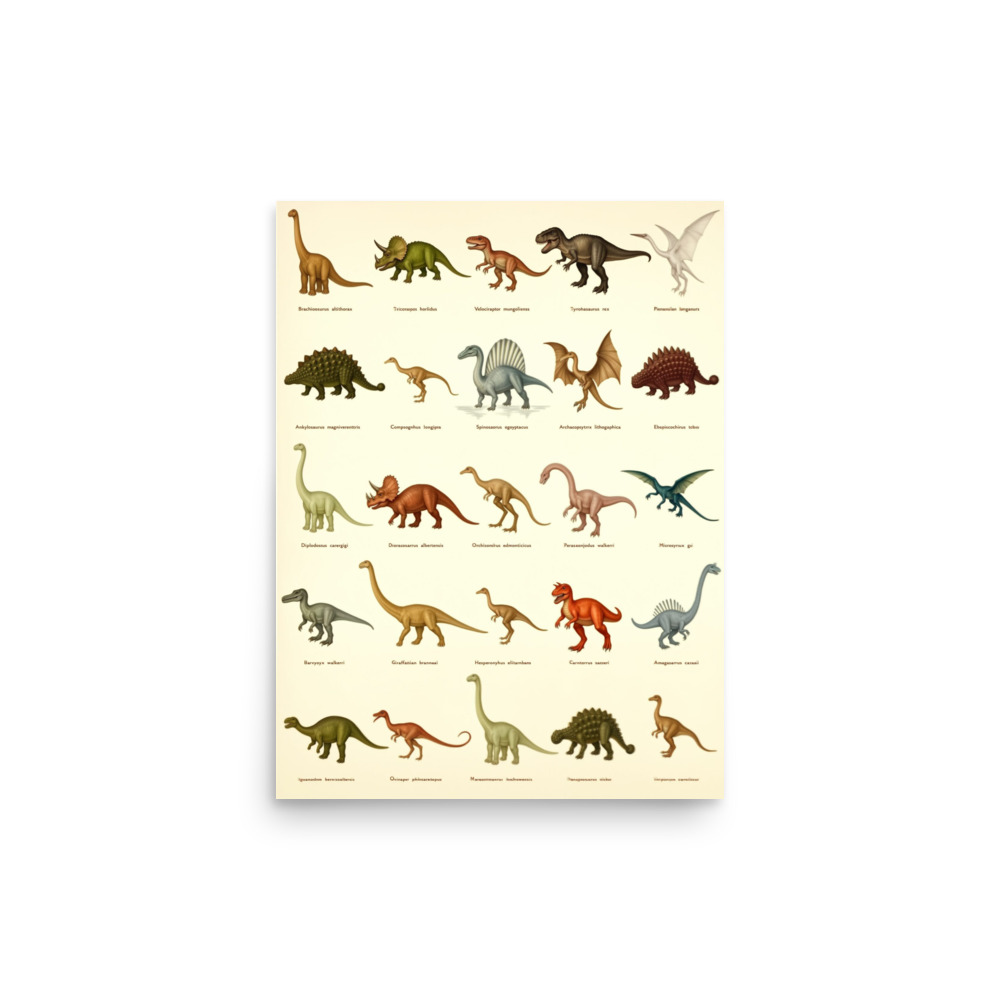
This educational dinosaur identification chart arranges colorful carnivore species in tidy rows, with detailed vintage watercolor illustrations and small clean serif labels against a warm cream background. Printed on Enhanced Matte Paper (189 g/m²), the art print brings a natural history feel to a study, playroom, classroom, or dinosaur-loving collector’s space, and makes a thoughtful gift for young learners.
A warm cream field meets the eye first, giving the whole composition the calm, ordered feel of a reference page. Across it, colorful carnivorous dinosaurs are arranged in tidy horizontal rows, each one separated by generous space so its stance and silhouette remain easy to read. Deep greens, ochres, rust reds, muted blues, and touches of charcoal give the animals variety without breaking the chart’s balance. Watercolor washes soften the edges of scales, backs, tails, and feet, while finer painted lines bring definition to teeth, claws, facial features, and overlapping limbs. The forms are lively rather than cartoonish: some creatures stand alert, some stretch forward, and others show the long tail and compact body shapes that make each entry distinct. Small, clean serif names sit near the illustrations, adding a quiet typographic rhythm and making the image feel both decorative and useful. The result suits a child who likes to study details, as well as an adult drawn to the measured beauty of old reference imagery.
Its visual language belongs to the vintage natural-history chart tradition, particularly the kind of illustrated educational plate associated with the late nineteenth and early twentieth centuries. A concrete marker of that style is the combination of individually presented specimens, restrained serif lettering, and carefully spaced rows, where every subject is given room to be examined. Rather than placing the dinosaurs in a dramatic landscape, the artwork treats them as observed forms on a page: isolated against a plain ground, identified by text, and rendered with enough variation in color and posture to invite comparison. The watercolor method adds a handmade quality, with gentle changes in tone across each body and small irregularities that keep the animals from looking mechanically reproduced. It has the character of a classroom reference sheet, a museum-study illustration, and a vintage children’s science book brought together in one composition. That balance makes it suitable for early readers learning names and shapes, while the restrained palette and orderly layout keep it from feeling limited to a nursery.
On the wall, this chart works especially well above a reading corner, a child’s desk, a low bookcase, or a shelf of dinosaur models and natural-history books. It can bring structure to a playroom with pale wood, soft green, clay, or mustard accents, and it sits naturally in a classroom alongside maps, alphabet materials, and framed botanical studies. In a study or collector’s space, pair it with an oak, walnut, or simple black frame to draw out the cream ground and the darker painted contours. Gentle daylight from a nearby window will reveal the transparent watercolor layers and the subtle shifts between olive, amber, brick, and blue-gray; warm evening light will make the cream background and earth tones feel softer and more intimate. Hang it where the rows can be viewed at eye level, allowing the labels and small painted features to reward a closer look. It is a considered choice for a young dinosaur enthusiast, a curious learner, or anyone who enjoys the quiet visual order of illustrated reference charts.
| Material | Enhanced Matte Paper (189 g/m²) |
| Digital printing | |
| Care | Frame or mount out of direct sunlight; wipe gently with a dry, soft cloth. |
| Shipping | Made to order — ships in 2–5 business days |